 Ha Long Bay Junk Boat Cruise
Halong Bay Weather: Month by Month and the Best Time to Visit
Halong Bay weather shapes every cruise on the water. The bay runs warm and humid from May to September with heavy rain and typhoon risk, then cooler and drier from October to April with morning fog in midwinter. This guide gives the monthly temperatures, rainfall, rainy days and sea temperatures for Ha Long Bay, explains who closes the bay when a storm arrives and what recent closures looked like. It also shows what each season means for swimming, kayaking and visibility on deck, so you can match the month to the cruise you want, from a Ha Long Bay junk boat cruises compared to two nights on the water.
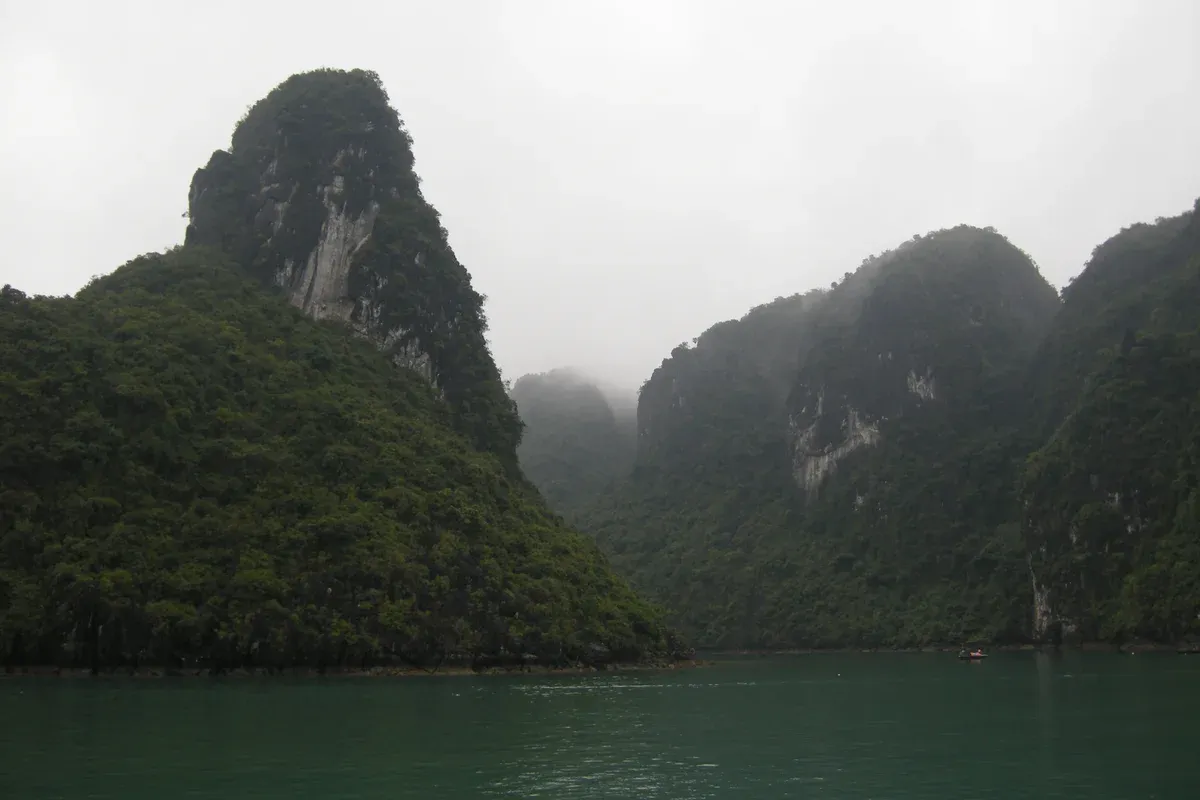
Tower karsts wrapped in fog on Ha Long Bay. Photo: Vyacheslav Argenberg, CC BY 4.0, via Wikimedia Commons
Quick answer Best time and climate at a glance
Halong Bay weather is at its best from October to November, when highs reach 26 to 29 degrees C (79 to 84 degrees F), rain drops to 55 to 119 mm a month. The wettest stretch runs May to September, with August the wettest at 312 mm, and typhoon season peaks July to October. Winter, December to February, is dry and cool at about 15 to 22 degrees C (59 to 72 degrees F) with fog on cold mornings. One guide calls October and November the best cruising months at 20 to 26 degrees C with minimal rain.
Key takeaways
- See how the numbers play out across the year in the Ha Long Bay weather by month table below.
- Short on time? A Day Cruise with Kayaking at $39 works in any dry month, and the bay authorities suspend boats when storms threaten.
- The dry months suit overnight trips such as the 2-Day Lan Ha Balcony Cruise at $126, with swimming and kayaking included.
- For a wider comparison of boats and bays, start with the Ha Long Bay junk boat cruise homepage, which sorts day cruises from Hanoi and overnight cruises.
Ha Long Bay Weather by Month
Twelve months of temperatures, rain and expectations, so you can see the whole year on one screen.
The Full Year in One Table
The table below compares all twelve months in Ha Long Bay. High and low temperatures come from the climate-zone averages for Ha Long, shown in degrees C with degrees F beside. Rainfall figures are the weather2travel monthly averages in mm, with the number of rainy days in brackets. The expectation column adds what the sources say actually happens on the water that month. Storm risk is covered in the sections after this table.
Read the rain column against the temperature column rather than on its own. A summer month can carry far more rain than a winter month and still average up to 7 hours of daily sunshine in July.
| Month | High / low | Rain | What to expect |
|---|---|---|---|
| January | 20 / 14 C (68 / 57 F) | 27 mm (10 rain days) | About 17 degrees C average, light fog on early mornings, sea at 19 C (66 F) |
| February | 21 / 15 C (70 / 59 F) | 31 mm (11 rain days) | Drizzle and mist common, only about 2 hours of daily sunshine |
| March | 23 / 18 C (73 / 64 F) | 43 mm (13 rain days) | Warming up, spring fog clears as the month goes on, sea reaches 20 C (68 F) |
| April | 27 / 21 C (81 / 70 F) | 91 mm (13 rain days) | Warm, sea at 23 C (73 F), swimming season is roughly starting |
| May | 31 / 24 C (88 / 75 F) | 168 mm (14 rain days) | Hot and humid, more than 150 mm of rain a month now falls, sea at 27 C (81 F) |
| June | 32 / 26 C (90 / 79 F) | 244 mm (15 rain days) | Peak heat at 32 degrees C, warmest water of the year begins, tropical storm activity can start |
| July | 32 / 26 C (90 / 79 F) | 267 mm (15 rain days) | Water at about 29 C (84 F), humidity peaks at 87 percent, typhoon season peak begins |
| August | 32 / 25 C (90 / 77 F) | 312 mm (16 rain days) | Wettest month of the year, tropical storm impact highest at 8.6 percent of the month |
| September | 31 / 24 C (88 / 75 F) | 206 mm (14 rain days) | Still hot and wet, typhoon risk continues, sea holds at 29 C (84 F) |
| October | 29 / 22 C (84 / 72 F) | 119 mm (11 rain days) | Drying out fast, one of the two best months, sea a warm 28 C (82 F) |
| November | 26 / 19 C (79 / 66 F) | 55 mm (8 rain days) | Fewest rain days of autumn, clear and settled, named among the best months by guides |
| December | 22 / 15 C (72 / 59 F) | 24 mm (7 rain days) | Cool and dry, lowest humidity of the year at 76 percent, sea eases to 22 C (72 F) |
How to Read the Table
Three patterns matter more than any single number. First, the dry season is also the cool season: December to February rainfall runs only 21 to 40 mm a month in one dataset, but the air on the water feels about 15 to 18 degrees C (59 to 64 degrees F) and warm layers are needed, according to a general Ha Long guide. Second, the rain is not spread evenly through the day.
More than 150 mm falls each month from May to October, yet daily sunshine still runs up to 7 hours in July, so a wet month does not mean a wasted cruise. Third, storm risk sits on top of the rainfall numbers. Weather2travel puts tropical storm impact highest in August at 8.6 percent of the month, with some activity June through October, so the wettest months are also the ones where the bay can close for a day or three.
Overall the Ha Long climate averages 15 to 25 degrees C (59 to 77 degrees F) across the year, with 2 to 2.2 m of rain, and Quang Ninh province averages 22.9 degrees C annually. If you want the full spread of boats for a given month, the comparison table of Ha Long Bay junk boat cruises on the homepage sorts them side by side.
Sources: climate-zone Ha Long, weather2travel Ha Long Bay, Climates to Travel
The Four Seasons on the Water
A month of numbers is one thing. Here is what each season actually feels like on a junk boat deck.
Winter: December to February, Cool, Dry and Foggy
Winter is the driest stretch on the bay. December to February rainfall runs only 21 to 40 mm a month by one dataset, and December records the year's lowest humidity at 76 percent. The trade-off is temperature.
Hai Phong WMO data show December to February at about 15 to 22 degrees C (59 to 72 degrees F), and Climates to Travel notes that cold spells can drop to 7 to 8 degrees C (45 to 46 degrees F). January averages about 17 degrees C (63 degrees F) and early mornings often carry light fog, while February adds drizzle and mist at an average of 18 degrees C (64 degrees F). Fog is common and can cut visibility on cold mornings, then lifts by midday.
The sea sits at its coldest, about 19 C (66 F) in January, so swimming is off the menu for most guests. Deck time calls for warm layers. If you cruise in winter, an overnight boat makes sense, because the fog clears while you are still on the water.
The Bhaya Classic Overnight Cruise at $120 lists Tai Chi and squid fishing on board.
Spring: March and April, Warming and Clearing
Spring is the season when the fog breaks. Hai Phong WMO data put March and April at about 18 to 27 degrees C (64 to 81 degrees F), and one Ha Long guide notes that spring fog clears. The sea warms from 20 C (68 F) in March to 23 C (73 F) in April, which brings the start of the swimming season that runs roughly April to October at 23 to 30 degrees C water.
Rain stays modest at 43 mm in March and 91 mm in April on the weather2travel figures, with 13 rainy days in each month. One weather guide names March to April for photography. Kayaking is allowed only in designated zones, and the operator confirms the spot on the day.
Sessions commonly last 45 to 60 minutes and life jackets are mandatory. Climates to Travel names mid-March to mid-April as one of the two best windows for the bay, and for good reason: you get clear air and mild temperatures before the summer humidity arrives.
Summer: May to September, Hot, Wet and Watchful
Summer is peak water and peak risk at the same time. Hai Phong WMO data show May to September at about 24 to 33 degrees C (75 to 91 degrees F), and Bai Tho Junks says June to August bring 30 to 32 degrees C (86 to 90 degrees F) with 179 to 262 mm of monthly rainfall and up to 16 rainy days. The reward is the sea: warmest water runs June to September at 28 to 30 degrees C (82 to 86 degrees F), and seatemperature.org puts the July peak at about 30.5 C (87 F).
Bioluminescent plankton can be seen on dark moonless nights, mainly in Lan Ha Bay, peaking around 20:00 to 22:00, though the glow is faint and not guaranteed. Against that stands the rain. May to September rainfall runs 202 to 361 mm a month in one dataset, August is the wettest at 312 mm on the weather2travel figures, and typhoon season runs July to September with August the highest risk.
Climates to Travel widens that window to late May to early November, peaking July to October, and one guide notes the peak for Bai Tu Long is August to October. When a warning comes, the whole bay can shut for typically 1 to 3 days. Summer does have one price advantage: one guide says Ha Long summer prices run 10 to 20 percent lower.
For swimmers this is the warmest-water season, as long as you keep a storm plan.
Autumn: October and November, the Quiet Peak
Autumn is the window most guides agree on. Hai Phong WMO data show October and November at about 19 to 30 degrees C (66 to 86 degrees F), and Bai Tho Junks calls October and November the best months at 20 to 26 degrees C (68 to 79 degrees F) with minimal rain. Rainfall falls from 119 mm in October to 55 mm in November on the weather2travel figures, and November has the fewest rain days of any autumn month at 8.
The sea stays swimmable at 28 C (82 F) in October and 25 C (77 F) in November, so you keep much of the summer water with fewer storms. Climates to Travel names late October to late November as the second of its two best windows. One caution: tropical typhoon risk can extend into October, so a cruise booked early in the month still needs a flexible cancellation policy.
Both of the best months are quiet on the rain gauge and kind to visibility, which is why they suit first-time visitors who want the towers sharp and the deck dry. A two-night option such as the 3-Day Lan Ha Bay Cruise at $301 makes the most of a settled spell, adding a bike ride to Viet Hai village and a beach afternoon at Ba Trai Dao. If your dates are fixed to December instead, the same logic applies in reverse: cooler air, dry skies and foggy starts.
Halong Bay Weather Explained: When to Go for the Best Experience
Explains the Ha Long Bay seasons and what the weather means for a cruise. Third-party video by Asia Pioneer Travel. This site did not shoot it and has no relationship with the creator.
Typhoons and Storm Closures
Ha Long Bay closes its waters when a storm threatens. The decision comes from the authorities, not the cruise companies.
When Storm Season Runs
Typhoon season for the bay runs from July to September, with August carrying the highest risk. Climates to Travel widens the window, saying typhoons can hit from late May to early November with the peak from July to October. For Bai Tu Long Bay, the risk peaks from August to October and can reach into October. August is also the wettest month on the water at around 312 to 327 mm of rain, so a storm warning often lands on top of an already rainy month.
One guide puts tropical storm impact at its highest in August, affecting about 8.6 percent of the month, with some activity from June through October. The chance of a 1 to 3 day bay shutdown is real in these months.
- July to September: core typhoon season for Ha Long Bay, August the highest risk
- June through October: some tropical storm activity per weather2travel
- August to October: peak risk for Bai Tu Long Bay
- A closure during a warning typically lasts 1 to 3 days
Who Decides and What the Threshold Is
The Ha Long Bay Management Board and the Inland Waterway Port Authority decide on boat suspensions. Cruise operators do not get a vote. When the board cancels for weather, operators often offer a full refund or free rebooking.
One operator guide cites cruise cancellations at winds of Beaufort level 6 or higher. During a suspension, boats that are already out on the water may still return passengers to the mainland, but no new departures go ahead. Day boats may also be ordered back early: during Storm Wutip on 13 June, day boats had to return passengers by 18:00.
Recent Closures on the Bay
Storm closures have happened in several of the last few years. The table pulls the recorded ones together. Note that after the Maysak reopening, most departures were overnight cruises because the remaining daylight was too short for day sightseeing.
| Storm | Dates | What happened |
|---|---|---|
| Typhoon Yagi | 7 to 9 September 2024 | All tourism halted. Yagi made landfall on 8 September with winds above 149 km/h and sank about 30 vessels at boat locks, 23 of them at Hai Au lock on Tuan Chau. Boats resumed normal operation on 13 September, and sights such as Sung Sot, Ti Top and Luon reopened from 10 September. |
| Storm Wutip | 13 June | All overnight boats suspended. Day boats had to return passengers by 18:00. |
| Typhoon Wipha | 20 July | All tourist boats banned from departing as the storm approached. |
| Storm Maysak | 5 July | The bay reopened at 14:00 after the storm weakened. Most departures that followed were overnight cruises. |
A Plain Word on Safety
On 19 July the Wonder Sea, a 24 m boat with 46 passengers and 3 crew, capsized at about 13:30 near Dau Go Cave in a sudden thunderstorm that investigators say may have formed a local tornado, and 39 people died. The boat had last passed inspection on 10 January. Storm warnings on the bay are taken seriously.
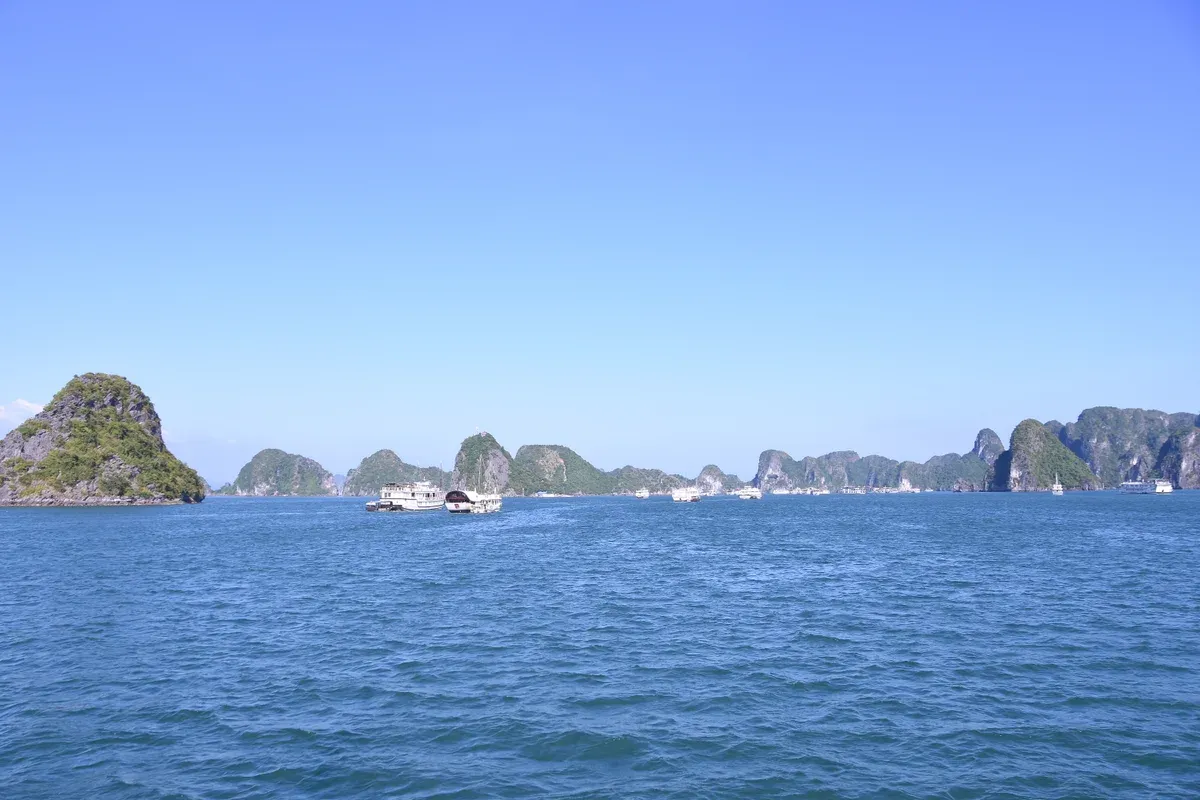
Karsts line the horizon as a boat crosses Ha Long Bay on a clear day. Photo: shankar s. from Dubai, united arab emirates, CC BY 2.0, via Wikimedia Commons
The Best Time to Visit Ha Long Bay
There is no single best month. The right window depends on if you want to swim, photograph or just cruise in comfort.
The Short Answer
Two windows come up again and again. Bai Tho Junks calls October and November the best months, at 20 to 26 degrees C (68 to 79 degrees F) with minimal rain. Climates to Travel names mid-March to mid-April and late October to late November as its best windows.
Vietnam Spot says October to November for cruising and names August as the month to avoid, with 312 mm of rain and the highest typhoon odds.
By Traveller Type
The honest answer changes with what you want from the trip. The table sets out the trade-offs from the climate figures and guide views above.
| Traveller | Best window | Why |
|---|---|---|
| Cruising in comfort | October to November | 20 to 26 degrees C (68 to 79 degrees F), minimal rain, 8 to 11 rainy days, sea still at 25 to 28 degrees C (77 to 82 degrees F). |
| Swimming | May to October | Swimming season is roughly April to October with water at 23 to 30 degrees C (73 to 86 degrees F). Warmest water is June to September at 28 to 30 degrees C (82 to 86 degrees F). |
| Photography | March to April | Fog clears, temperatures rise to 18 to 27 degrees C (64 to 81 degrees F), and spring light suits the karst. Vietnam Spot names March to April for photography. |
| Lowest prices | Summer | Summer prices run 10 to 20 percent lower, but you trade that against 202 to 361 mm of monthly rain and storm risk. |
| Mist and cool weather | December to February | Only 21 to 40 mm of rain a month, but fog on cold mornings, 2 sunshine hours a day in February, and water too cool for most swimmers at 19 to 22 degrees C (66 to 72 degrees F). |
Tet and the Crowd Calendar
Lunar New Year falls on Saturday 6 February, with the eve on Friday 5 February. The heaviest Tet travel crush is expected around 3 to 5 February outbound and 9 to 12 February for the return, and fares in the Tet 2026 period doubled or tripled. Around Tet, small restaurants, shops, museums and banks close for the first three days, 6 to 8 February, while hotels and businesses in tourist areas mostly stay open.
A 7-day break of 4 to 10 February was backed by the culture ministry but was still awaiting confirmation, so check the final holiday dates before locking in plans.
Choosing a Cruise for the Season
In the October to November window, the water is still warm enough for the swim and kayak stops that most itineraries include. The 2-Day Lan Ha Balcony Cruise at $126 includes kayaking, swimming and Tai Chi with all entry fees. In winter, an overnight boat such as the Bhaya Classic Overnight Cruise at $120 makes sense because the deck time splits across two days and fog usually lifts by midday.
For a cheap summer day trip when storms are the main risk, the Day Cruise with Kayaking at $39 carries free cancellation up to 24 hours before, which is useful if the forecast turns.
Sources: Climates to Travel, Bai Tho Junks
Weather Tips for Ha Long Bay
Practical do's and don'ts, all drawn from the climate data and closure rules above.
Do
- Do book a cruise with free cancellation up to 24 hours in typhoon season, because the board can suspend boats when storms threaten and you want to walk away cheaply.
- Do bring warm layers for a winter cruise, because the air on the water feels about 15 to 18 degrees C (59 to 64 degrees F) and cold spells can drop to 7 to 8 degrees C (45 to 46 degrees F).
- Do plan cave and viewpoint stops for the afternoon in winter, because morning fog can cut visibility and usually lifts by midday.
- Do swim between April and October, when the water sits at 23 to 30 degrees C (73 to 86 degrees F) and peaks at 28 to 30 degrees C (82 to 86 degrees F) from June to September.
- Do ask about a full refund or free rebooking if the Ha Long Bay Management Board cancels for weather, since operators often offer one of them.
Don't
- Don't count on a cruise in August, the wettest month at 312 to 327 mm of rain and the highest typhoon risk of the year.
- Don't assume the operator decides on storm days, because the Ha Long Bay Management Board and the Inland Waterway Port Authority make the call, not the cruise company.
- Don't rely on kayaking outside the approved zones, since kayaking is allowed only in designated zones, and life jackets are mandatory.
- Don't travel in the Tet crush expecting normal prices, because fares around Lunar New Year doubled or tripled in the Tet 2026 period.
Weather FAQ
When is typhoon season in Ha Long Bay?
July to September, with August the highest risk month. Some tropical storm activity runs from June through October, and Bai Tu Long Bay's peak sits from August to October. See the storm closure record for what recent warnings meant on the water.
What happens if a storm closes Ha Long Bay during my cruise?
The Ha Long Bay Management Board and the Inland Waterway Port Authority suspend boats, usually for 1 to 3 days, and operators often offer a full refund or free rebooking. Recent closures include Yagi in 2024, Wutip and Wipha and Maysak. The typhoon and closure section lists each one with dates.
Can you swim in Ha Long Bay in winter?
You can, but most people do not. The sea cools to about 19 to 22 degrees C (66 to 72 degrees F) from December to February, while the swimming season with water at 23 to 30 degrees C (73 to 86 degrees F) runs from roughly April to October. The best time by traveller type section matches the season to the activity.
Why is Ha Long Bay foggy in the morning?
Winter fog is common on cold mornings from December to February, when rainfall is low at 21 to 40 mm a month. January averages about 17 degrees C (63 degrees F) with light fog, and it usually lifts by midday. An overnight cruise such as the Bhaya Classic puts you on the bay for the clear afternoon.
Is August a bad month for a Ha Long Bay cruise?
It is the riskiest month. August is the wettest at 312 to 327 mm of rain with about 16 rainy days, and it carries the highest typhoon odds of the year. Summer prices do run 10 to 20 percent lower, so some travellers take the gamble. Compare options in the Ha Long Bay junk boat cruises compared before deciding.
How does Tet affect a trip to Ha Long Bay?
Lunar New Year falls on 6 February, with the heaviest travel crush expected around 3 to 5 February outbound and 9 to 12 February returning. Fares doubled or tripled around the Tet 2026 period, and small businesses close for the first three days. Some cruises add a Tet surcharge, for example $15 per person on the Deluxe Day Cruise from Hanoi from 5 to 9 February.